

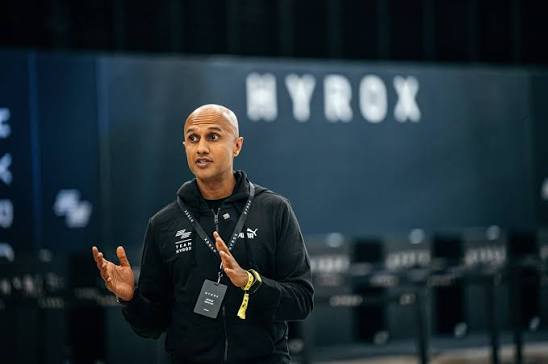
Deepak Raj is a premier sports event organizer and endurance athlete who serves as the General Manager for HYROX India and the Country Director for Ironman India. A multi-time Ironman finisher himself, he has played a pivotal role in pioneering fitness properties across the Indian subcontinent. Under his leadership, Ironman India has expanded from its flagship event in Goa to new host cities like Ahmedabad and Chennai, while HYROX India has achieved a 10x growth trajectory—expanding to major metropolitan centers including Mumbai, Bengaluru, Delhi NCR (Noida), and Gujarat, with an eye toward future Olympic and Commonwealth Games inclusion. Deepak spoke with The Playknox founder Taruka to spotlight on both Hyrox and Ironman in India.
HYROX has rapidly taken over the country’s fitness landscape. How did the idea of bringing HYROX to India first come about?
Having organized Ironman events in India for several years, we were always looking for new avenues to encourage movement and keep people active. After reading about HYROX, we reached out to their global team through a cold email expressing our interest in bringing the format to India. It required building a team and pitching a comprehensive business case to convince them. We strongly felt that India was ready to absorb a new mass-participation fitness sport centered on functional movement and long-term health.
What has been the response to HYROX in India so far, especially with national initiatives like the Fit India Movement gaining momentum?
The response has been phenomenal. Our inaugural race 15 to 16 months ago drew around 1,600 participants, while our recent Mumbai event saw 15,500 athletes—a 10x growth rate. People are increasingly seeking quantifiable fitness goals to stay active and improve their health. This aligns directly with national fitness initiatives, and we are continually working to expand our footprint to support active lifestyles.
Many participants compete in consecutive HYROX events across different cities, and it has gained significant traction among millennials and people in their 30s. Why do you think it has become such a lifestyle trend?
HYROX is inherently content-friendly and spectator-centric. Unlike traditional marathons, spectators are positioned right next to the action, making it easy for friends and family to record content and cheer on athletes in an energetic, music-filled atmosphere. Additionally, gyms represent the largest sporting infrastructure globally—far outnumbering tennis or padel courts—meaning millions of people already train in gyms but previously lacked a standardized competition. HYROX provides a measurable benchmark, such as improving a total time or a specific station like the sled push. It also serves as a perfect intersection for runners looking to strength train and gym-goers adding endurance work.
What has been the response from corporate, national, and global brands looking to partner with HYROX in India?
A: Brand response has been exceptionally strong because the high social media visibility offers clear, quantifiable engagement. We work with global partners, national sponsors like IndusInd Bank, educational institutions like Masters’ Union, and major global brands like Puma and Red Bull. Beyond sports apparel and nutrition, mainstream non-endemic brands like automotive companies and banks are actively partnering with us due to the deep integration opportunities we offer beyond standard logo placement.
What are the primary operational challenges in hosting HYROX events across Indian cities?
Unlike outdoor events like Ironman that require extensive road closures and public permits, HYROX is held indoors in controlled venues. The main challenge is securing sufficiently large indoor spaces—specifically 12,500 to 15,000 square meters of air-conditioned, pillar-free floor space. Venue availability in certain tier-1 and tier-2 cities dictates our expansion pace. Despite this, our recent event drew participants from over 400 cities, towns, and villages across India. We are currently active in five cities and plan to expand to a sixth and seventh location soon.
Looking at triathlon, how has the endurance culture evolved around Ironman in India?
When we launched Ironman 70.3 Goa in October 2019, triathlon was a niche concept in India. Today, participation levels have surged. Our Goa event expects close to 2,000 athletes, up from 1,250 last year, prompting us to add Ahmedabad to the calendar alongside Chennai. While triathlon has higher entry barriers—such as swimming proficiency and equipment costs—the discipline and community interest have grown significantly, allowing us to introduce new regions and relay formats to make the sport more accessible.
What is the long-term strategic vision for both Ironman and HYROX in India?
For Ironman, the strategy is to expand beyond Goa and Ahmedabad into additional regions while introducing relay formats to lower the barrier to entry. For HYROX, the objective is to scale existing event capacities in key metros like Mumbai, Bengaluru, Delhi NCR (Noida), and Gujarat while adding select new host cities. Maintaining a product-first and community-centric focus remains the primary operational goal.
Is the ultimate ambition for HYROX to be recognized as an official event in major global multi-sporting competitions like the Asian Games, Commonwealth Games, or Olympics?
Yes. While 2028 was too early due to formal federation recognition pathways, 2032 and 2036 are active targets for Olympic inclusion. As the global governing framework for fitness racing formalizes across national sports federations, inclusion in regional multi-sport events like the Asian Games and Commonwealth Games will naturally follow. With India hosting the 2030 Commonwealth Games, there is strong strategic interest in positioning fitness racing within that broader international ecosystem.