

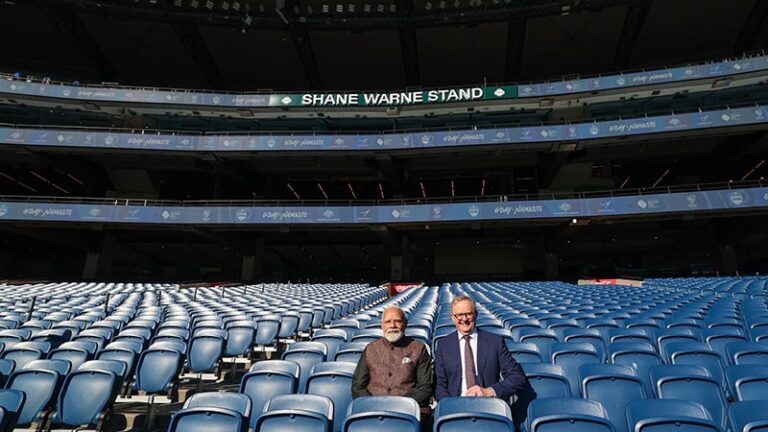
India and Australia have unveiled an ambitious India-Australia Roadmap for Sports Collaboration, signalling a new phase in their bilateral relationship where sport is positioned not merely as competition, but as a strategic pillar of diplomacy, innovation and economic cooperation.
Building on the 2023 Memorandum of Understanding (MoU) on Cooperation in Sports, the roadmap outlines a long-term vision to strengthen collaboration across athlete development, sports science, coaching, major events, sports business and women’s participation. It also recognises the unique opportunity presented by a decade of major sporting events, including the 2030 Commonwealth Games in Ahmedabad, the Brisbane 2032 Olympic and Paralympic Games, and India’s ambition to host a future edition of the Olympic and Paralympic Games.
Rather than creating a one-size-fits-all framework, the roadmap acknowledges the different sporting ecosystems in both countries while encouraging governments, national sporting organisations, universities, businesses and community groups to work together through flexible, outcomes-focused partnerships.
Building High-Performance Sporting Systems
One of the central pillars of the agreement focuses on developing world-class high-performance environments.
Australia will share expertise in establishing and operating High-Performance Sports Centres in India while expanding collaboration in coach education through two-way exchange programmes. Indian coaches will have opportunities to learn from Australia’s internationally recognised coaching systems, while Australian coaches will also engage with Indian sporting institutions through a “Train the Trainer” model.
Para sport has also been identified as a major area of cooperation. The roadmap proposes collaboration in athlete classification, coaching methodologies and performance support, alongside partnerships between Indian and Australian universities to strengthen research and education in para sport.
The agreement also explores scholarship opportunities that would allow talented Indian athletes to access high-performance training programmes in Australia through partnerships with universities and sporting organisations.
Driving Innovation Through Sports Science and Technology
Recognising the growing role of technology in elite performance, both nations have committed to expanding collaboration in sports science research.
Universities from both countries will be encouraged to undertake joint research in athlete performance analytics, injury prevention, sports nutrition, wearable technologies, recovery science and para sport. The roadmap also promotes the co-development of sports education curricula, strengthening academic exchanges between Indian and Australian institutions.
Integrity in sport also forms part of the collaboration, with Sport Integrity Australia and India’s National Anti-Doping Agency expected to strengthen cooperation through World Anti-Doping Agency-led capacity-building initiatives.
Leveraging Major Sporting Events
With both countries preparing to host some of the world’s biggest sporting events over the next decade, the roadmap places significant emphasis on knowledge sharing around event delivery.
Australian states, territories and sporting organisations will exchange expertise with Indian counterparts on hosting major international events, venue management and operational planning.
The agreement also encourages exhibition matches and youth competitions to promote sports of mutual interest. This includes expanding opportunities for Kabaddi and Kho Kho in Australia, while introducing more Australian sports such as Australian Rules Football and basketball within India.
Cricket also features prominently in the roadmap. Following the announcement that the inaugural Big Bash League match will be played in Chennai in December 2026, Cricket Australia and the Board of Control for Cricket in India have been encouraged to work towards establishing annual BBL matches in India, creating new commercial and fan engagement opportunities.
Unlocking Growth Across the Sports Industry
Beyond athlete development, the roadmap recognises sport as an increasingly important economic sector.
Both governments will support greater collaboration between Indian and Australian companies across sports equipment manufacturing, sports media and broadcasting, event management and sports technology startups.
The Australia-funded Sports Industry Summit, scheduled to be held in Mumbai later this year, is expected to provide a platform for businesses from both countries to explore commercial partnerships and investment opportunities.
The roadmap also seeks to facilitate Australian companies entering India’s rapidly expanding sports market while encouraging greater exports of Indian sporting goods to Australia. At the same time, Australian expertise in coaching, athlete wellbeing, nutrition, strength and conditioning and sports psychology is expected to play a larger role within India’s evolving high-performance ecosystem.
Advancing Women in Sport
Women’s sport has emerged as another key area of collaboration. The roadmap proposes joint initiatives focused on increasing women’s leadership, participation and high-performance opportunities, drawing on successful programmes developed by the Australian Sports Commission. These initiatives are expected to include bilateral competitions, leadership programmes and projects promoting sport as a tool for women’s health, economic empowerment and social inclusion.
Sport as a Strategic Bridge
While many bilateral agreements focus primarily on trade or security, the India-Australia Roadmap for Sports Collaboration reflects a broader understanding of sport’s role in international relations.
By bringing together governments, universities, sporting organisations, businesses and athletes, the roadmap positions sport as a platform for knowledge exchange, innovation, economic growth and people-to-people connections.
As both nations prepare to host some of the world’s biggest sporting events over the next decade, this partnership aims not only to improve sporting performance but also to strengthen one of the Indo-Pacific’s most significant strategic relationships through the universal language of sport.